How to Cut Business Energy Costs This Winter
And reduce your carbon footprint at the same time
There’s no doubt we are in the middle of a perfect storm for small businesses: rocketing interest rates, sky high inflation and the very real prospect of a recession. Much of this has been driven by mind-blowing increases in energy prices. Many households are paying double what they were 12 months ago. And for many businesses it’s significantly more.
So, we thought we’d offer a few simple pointers that will help businesses plan effective ways to reduce energy bills, reduce costs and reduce their carbon emissions.
At home
No doubt we are all going to become ‘good housekeepers’ this winter. It’s in our interests. We’ve all read the top tips: switching off lights, fill the dishwasher, reduce the number of showers we have, turn off radiators in rooms we don’t use. I live in a big and badly insulated Victorian terraced house. I’ve done my best to insulate it and I’ve got a modern boiler with a SMART thermostat. I’m washing less clothes (much to my partner’s dismay) and washing on a 30-degree wash. However, the big elephant in the room is now rearing its trunk…how to keep warm!
I switched the timer on the heating as a trial this week and my daily energy cost trebled! I’ve stacked the house with logs as I’m loathed to hit the green button on the boiler again until I see perspiration on my breath. The kids are just going to have to wrap up warm. The point I’m making here is that, as householders, its in our best interests to become more resource efficient as it benefits our personal bottom line as well as those who ‘want to make a difference’. But for businesses, the same premise does not always apply…
At work
At Green Gain, we have performed resource efficiency audits on over 250 SMEs over the past 5 years, but nothing has prepared us for the alarming energy bill hikes we have witnessed recently. No doubt the Government’s intervention will help businesses. But for how long?
Can you as a business become a lot leaner in 6 months? Well, yes, you can.
Simply adopting the good housekeeping we have introduced at home can lead to significant annual savings, to the tune of 5% to 10%. But to do this you need to understand your baseload. An experiment after hours (on a Friday afternoon after your site closes), is to go around and switch off all electrical equipment (except servers and refrigerators, of course), which will reveal your baseload, considering the various operational functions that exist. This is the lowest amount of energy that will be used when your site is not operational. This will be above zero, as items such as servers will still be operating. This ‘Baseload’ should be fixed as the lowest common denominator that staff should achieve at lock up. Significant savings can be found by reducing and ensuring this baseload target is met every evening prior to lock up. If the baseload rises, then something has been left on. For example, a reduction of 200W in the baseload overnight would lead to a £150/yr saving. By looking at a weekly energy use graph on your web platform, anomalies in energy use can be picked up immediately due to faulty equipment or overuse. The unusual spike in electricity consumption should be highlighted and investigated.
Changing workforce behaviour
So how can you, as a business, influence behaviour change? Use the ‘Nudge’ effect – make it personal. Use the right language for the target audience. Unless you are addressing a technical audience, do not use technical language:
·Keep it simple and appropriate. Be aware of the language that you already use to communicate. Does it work? What gets noticed?
·Your first communications are very important. An attention-grabbing, thought-provoking message will interest people in energy-saving and lessen their initial resistance.
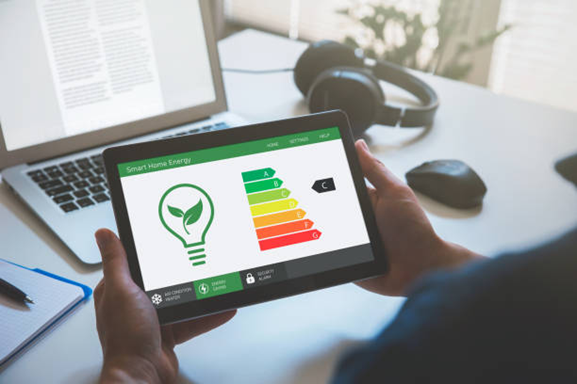
By having a visual display of live energy consumption, engagement with all the staff can be more readily achieved. It makes saving energy everybody’s responsibility, as they can see what they are using and know how much they could reduce this by.
Appoint a member of your staff to review the energy use and check bills regularly. Does someone check everything is switched off (except refrigerators and servers) when the premises are closed on a Friday evening?)
Lighting up the workplace
Once you have started to embark upon a behaviour change campaign, what else can you do? Well, first and foremost look at your lighting. Moving to LEDs will reduce electricity consumption by up to 90% when compared to traditional incandescent and halogen lighting. Further savings can be made by the installation of PIR motion / photo-sensors (which turn off some or all lights when there is sufficient daylight) and movement sensors (which turns the lights on in a zone only while people are in that zone) which would lead to further savings for the new lights. To avoid all lights being turned off suddenly when daylight levels increase, photo-sensors can be configured to turn off only some lights or to dim the lights in response to daylight levels, if the new lights are dimmable. A low-cost option is to consider installing sensors in low occupancy areas. Occupancy sensors detect the presence or absence of people and turn lights on and off accordingly. They may reduce lighting energy consumption by 35-45% and can go up to as high as 75%. They are small, inexpensive, low-power, easy to use and do not wear out. They can be purchased for as little as £10 per unit.
Motor management
For manufacturing companies, the use of motors represents the ‘beating heart’ of the company. Without them operations crumble. But many companies still rely on fixed speed drives for air extraction and air compressors. Make a wholesale move to the use of Variable Speed Drives (VSDs) The major benefit of using a VSD in compressor applications, for example, is that it automatically adjusts its motor speed to the air demand. Estimates vary, but in terms of energy savings, using a VSD compressor in comparison to a fixed speed, idling or load/unload compressor, could comfortably produce energy savings of 35-50%. The energy efficiency best practise programme estimates that electricity use, due to compressed air, for an average manufacturing plant, uses around 10% of total electricity consumption.
Heating empty space
And here comes that elephant again. Heating. So much energy is wasted by businesses through heating air that simply disappears through the roof and the back door. We regularly visit companies that have large 100kw floor and ceiling mounted gas-powered air heaters. In many cases, this heat disappears straight through a badly insulated roof or permanently open roller shutter. To help combat this wasteful practice insulate as best you can, install destratification fans to push hot air downwards and adjust timer and temperature settings. These devices can save between 20% and 50% on heating requirements. For staff wellbeing, health and safety regulations state that employers must ensure that the temperature in the workplace is ‘reasonable’ at all times. In accompanying codes of practice, it suggests that the temperature should be a minimum of 16°C unless the work involves a lot of physical activity where this can drop to 13°C. Heating costs rise by about 8% for each 1°C of overheating. It is also worth regularly checking settings. Many systems are set incorrectly because someone has made a short-term adjustment and then forgotten about it. And many heating systems are simply oversized for the workplace.
For dramatic changes that do require investment, look to install insulated and automated roller shutters, and, if your operatives are static and placed at workstations, then consider the adoption of electric radiant heating and possibly the installation of Air Source Heat Pumps (ASHPs). These work well with solar PV, if you are hoping to ‘wean’ yourself off the grid. If you generate large amounts of wood waste, consider the installation of waste wood heaters. Turn waste into energy.
Longer term investments
If you’re a freeholder, a long leaseholder of a building or a landlord, renewable energy options are usually a cost-effective investment over the mid to long term. They cut energy costs and emissions and can even generate income over the longer term. There has been a marked increased appetite for solar PV since the start of this energy crisis. Despite the absence of the Feed In Tariff (FIT), the cost of the panels have reduced as have the payback periods. Two years ago we were seeing average payback periods of 10 to 12 years. Now that payback has halved. The typical cost of small-scale installations (4-10 kWs) is approximately £1,500 per kw installed. For any energy you don’t use, you can benefit from the Smart Export Guarantee (SEG) which launched on the 1st January 2020. The new scheme applies to businesses and homeowners who are installing new renewable energy systems allowing them to be compensated for any excess electricity exported back to the grid. Under the scheme, each energy supplier sets the price they are prepared to pay for excess electricity. This is set at approximately 5p/kWh.
Act today and plan for the future
These are just a few of the things you can do to make your business leaner and greener over the next few months.
·Translate your behaviour changes from your home to your business
·Assess your consumption spikes and base loads
·Understand where the ‘leakages’ lie
·Adopt low-cost resource efficiency improvements
·And develop a longer-term strategy for ‘weaning’ yourself off the grid through the adoption of renewable energy technologies.
It all makes good business sense and helps reduce our collective carbon impacts. We all have a part to play in this. And there really is no time like the present.